Thirty days. One finished manuscript. It sounds aggressive, and it is. But thousands of writers do it every year. NaNoWriMo proved that a deadline and a daily word count target beat waiting for inspiration. The mechanics are the same for fiction and nonfiction: break the project into phases, hit your numbers each day, and don't look back until you reach the end.
This guide gives you a concrete, week-by-week plan to write a book in 30 days. Not a rough draft you'll abandon, but a complete manuscript you can actually edit and publish.
The Math: Daily Word Counts by Book Length
Before you start, you need to know your target. Different book lengths require different daily commitments, and the numbers across 30 writing days look like this:
- 40,000 words (short nonfiction, novellas): 1,334 words/day
- 50,000 words (standard novel, NaNoWriMo target): 1,667 words/day
- 60,000 words (full-length novel): 2,000 words/day
- 70,000 words (longer fiction, detailed nonfiction): 2,334 words/day
- 80,000 words (epic fiction, in-depth guides): 2,667 words/day
For most first-time authors, 50,000 words in 30 days is the sweet spot. That's roughly 1,667 words per day, about 90 minutes of focused writing for an average typist. If you're writing nonfiction, 40,000 words is perfectly respectable for a published book.
Pick your target now. Write it down. Everything else flows from this number.
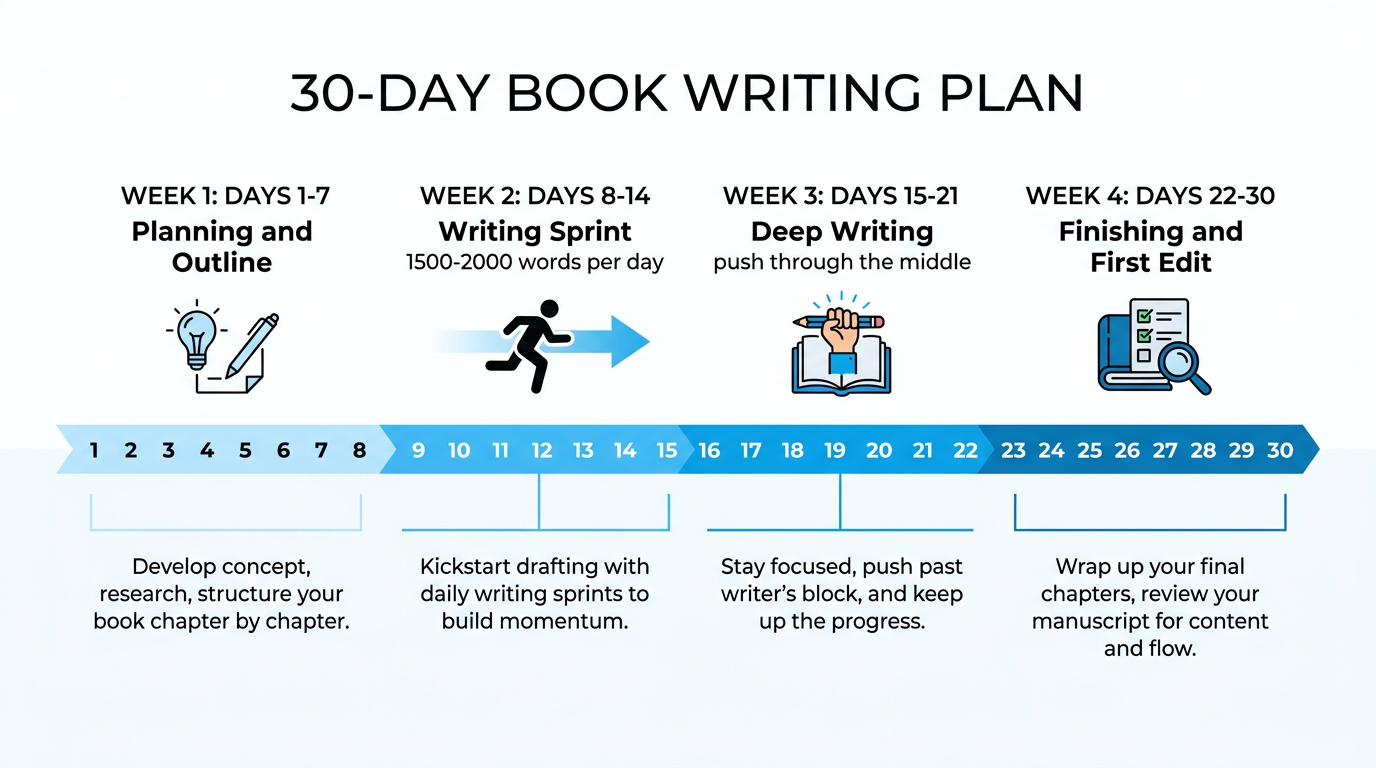
Week 1 (Days 1-7): Planning and Preparation
The biggest mistake in a 30-day book writing challenge is starting to write on day one. Writers who skip planning either stall out around day 10 or finish a manuscript so structurally broken it can't be salvaged. Spend the first week building a foundation.
Days 1-2: Nail Down Your Concept
Write a one-paragraph summary of your book. For fiction, this means your protagonist, the central conflict, and the stakes. For nonfiction, it means your thesis, your target reader, and the transformation you're promising.
If you can't summarize your book in one paragraph, you don't know it well enough to write it yet. Keep refining until the concept is tight.
Days 3-4: Build Your Outline
For fiction: Map out your story structure. You don't need to follow a rigid formula, but you do need to know your beginning, your midpoint, and your ending. Write a one-sentence summary for each chapter. Aim for 15 to 25 chapters depending on your word count target.
For nonfiction: List every chapter with a clear topic and 3-5 key points each chapter needs to cover. Your chapters should follow a logical progression, each one building on the last. A reader should be able to scan your table of contents and understand the book's argument.
Days 5-6: Character Work (Fiction) or Research (Nonfiction)
Fiction writers: write brief sketches for your main characters. You need to know what they want, what's stopping them, and how they talk. You don't need a 10-page backstory. A half-page per major character is enough to write them consistently.
Nonfiction writers: gather your research, sources, statistics, and examples. Organize them by chapter. You'll write much faster when you're not stopping to look things up mid-sentence.
Day 7: Set Up Your Writing System
Choose your writing tool and create your file structure. Set up your daily writing schedule: same time, same place, every day. Tell the people in your life what you're doing. Prepare your workspace. Remove distractions. Tomorrow, you write.
Week 2 (Days 8-14): The Writing Sprint
This is where the real work begins. Your outline is done. Your characters or chapter structures are mapped. Now you write — every single day, no exceptions.
Daily Target: 1,500-2,000 Words
For a 50,000-word book, you now have 23 writing days left (days 8-30). That means roughly 2,175 words per day. The first week of actual writing tends to go fast because you're energized. Use that momentum. If you can bank extra words now, say 2,500 or 3,000 in a day, you'll thank yourself during week three.
The First-Chapter Problem
Many writers spend three days perfecting their opening chapter and never recover the lost time. Your first chapter will almost certainly be rewritten during editing. Write it, make it decent, and move on. You cannot edit a blank page, but you can fix a rough one.
Writing Sprint Technique
If staring at a blank document for 90 minutes sounds miserable, break your sessions into sprints:
- Set a timer for 25 minutes
- Write without stopping — no editing, no re-reading, no research
- Take a 5-minute break
- Repeat 3-4 times to hit your daily target
Most writers produce 500-800 words per 25-minute sprint. Three sprints get you to 1,500 words minimum. Four sprints put you comfortably over 2,000.
Week 3 (Days 15-21): The Middle
Week three is where books die. The excitement of starting has faded. The ending feels impossibly far away. Your inner critic has had two weeks to build a case for why this project is terrible. Every writer who has ever finished a book has pushed through this exact wall.
Why the Middle Is Hard
In fiction, the middle is where your plot has to develop and deepen without the natural momentum of a beginning or ending. In nonfiction, it's where you're deep in your subject and the chapters start feeling repetitive. Both are normal. Neither is a reason to quit.
How to Push Through
- Write out of order. If the chapter you're on feels like pulling teeth, skip to one that excites you. You can fill the gaps later.
- Lower the bar temporarily. Your goal this week is words on the page, not brilliance. Give yourself permission to write badly. You'll fix it in editing.
- Re-read your outline. Remind yourself where the story is going. The middle feels aimless when you've lost sight of the destination.
- Track your progress visually. A simple spreadsheet or word count tracker showing your cumulative progress can be surprisingly motivating. Watching the number climb makes it harder to break the streak.
- Don't re-read what you've written. Going back to "fix" earlier chapters is a trap. It feels productive but it's avoidance. Forward only.
Maintaining Your Pace
If you banked extra words during week two, this is where they pay off. A day where you only write 1,200 words doesn't feel like failure if you're still ahead of schedule overall. If you're behind, don't try to catch up in one marathon session. Instead, add 200-300 extra words to each of the remaining days.
Week 4 (Days 22-30): Finishing Strong
The final stretch. You can see the end now. This is where the plan pays off — you know exactly how many chapters remain, and your outline tells you what happens in each one.
Days 22-26: Write the Ending
Endings are easier to write than middles because you have a destination. For fiction, your climax and resolution should feel inevitable based on everything you've set up. For nonfiction, your final chapters should synthesize your argument and give readers clear next steps.
Write the ending you planned, even if the book has drifted from your outline. You can reconcile inconsistencies during editing. Right now, finishing matters more than perfection.
Days 27-28: Fill the Gaps
Go back to any scenes or sections you skipped. Write transitions between chapters that feel disconnected. Add any missing content that your outline called for but you bypassed during the sprint. This isn't editing. It's completing.
Days 29-30: First-Pass Review
Read through your manuscript from beginning to end. Don't edit line by line; that's a separate process that takes weeks. Focus on structure instead:
- Does the book flow logically from chapter to chapter?
- Are there any major plot holes or missing arguments?
- Is the ending satisfying?
- Are there chapters that should be cut, merged, or reordered?
Make notes on what needs work, but resist the urge to start rewriting. You now have a complete manuscript. That puts you ahead of the vast majority of people who say they want to write a book.
Productivity Tips That Actually Work
Every "how to write a book fast" article lists the same generic advice. These are the ones that actually make a difference, based on what working writers do:
- Write at the same time every day. Your brain learns to be creative on cue. Morning works best for most people because willpower is highest and the day hasn't thrown curveballs yet.
- Write before you do anything else. Checking email, scrolling social media, reading the news. All of these drain the mental energy you need for writing. Words first, world second.
- Use a distraction-free writing tool. Full-screen mode, no notifications, no browser tabs. Some writers use apps like FocusWriter or iA Writer. Others just disconnect from WiFi.
- End each session mid-sentence. This is Hemingway's trick. When you stop in the middle of a thought, you know exactly where to pick up tomorrow. It eliminates the "where was I?" problem that kills momentum.
- Don't tell people about your book (too much). Research suggests that talking about your goals gives you a premature sense of accomplishment. Tell one or two accountability partners. Save the announcement for when it's done.
Common Pitfalls and How to Avoid Them
These are the mistakes that derail 30-day writing challenges most often:
- Editing while you write. This is the single biggest productivity killer. First drafts are supposed to be rough. If you spend 20 minutes choosing the perfect word for a sentence that might get cut anyway, you're burning time you don't have.
- Skipping days and planning to "make it up." One skipped day becomes two. Two becomes a week. A week becomes "I'll try again next month." Write something every day, even if it's only 500 words on a bad day.
- Changing your outline mid-project. If you realize your plot or structure needs to change, make a note and keep writing the current version. Major structural changes during a sprint kill momentum and create confusion. Fix it in revision.
- Comparing your first draft to published books. Published books have been through multiple rounds of editing, professional proofreading, and beta readers. Your first draft is raw material. That's exactly what it should be.
- Not having an outline. "Pantsing" (writing by the seat of your pants) works for some experienced writers. For a 30-day challenge, it's a gamble. Even a loose outline gives you a roadmap when you're stuck at 2 AM wondering what happens next.
After Day 30: What Comes Next
You have a finished manuscript. Congratulations. Seriously, most people never get here. But a first draft is not a finished book. The path from manuscript to published looks like this:
- Let it rest. Put the manuscript away for at least two weeks. You need distance before you can edit objectively.
- Structural edit. Reorder chapters, cut what doesn't serve the book, expand what's thin.
- Line edit. Tighten prose, fix dialogue, improve clarity.
- Proofreading. Catch typos, grammar errors, and formatting issues.
- Cover design and formatting. Your book needs a professional cover and proper interior formatting for publishing on Amazon KDP.
The editing process typically takes 4-8 weeks, depending on how much rewriting is needed. Budget for it. Your 30-day sprint got you the hardest part: a complete draft. Everything from here is refinement.
The Faster Path: AI-Assisted Book Writing
The 30-day plan above works. Thousands of writers have used it successfully. But it demands a serious time commitment: 90 minutes to two hours of focused writing, every single day, for a month straight. Not everyone has that kind of schedule.
AI book writing tools have changed this calculus. Instead of spending 30 days producing a first draft, a platform like BookSmith can generate a complete, structured manuscript in hours, with chapter-by-chapter output, voice consistency, and publish-ready formatting built in.
The AI handles the drafting grind so you can spend your time on what actually matters: refining your ideas, shaping the voice, and making the book genuinely yours. You still review and approve every chapter. You still control the direction. But the part that takes most writers a month takes an afternoon.
If the 30-day challenge appeals to you, go for it. The discipline of daily writing is valuable on its own. But if your goal is to get a book published rather than to build a daily writing habit, there are faster ways to get there.
Try BookSmith free and start with a free outline. See what your book looks like before committing to the full manuscript.