A year ago, writing a book with AI meant copying and pasting ChatGPT outputs into a Word doc and hoping for the best. The results were predictable: bland, repetitive, and obviously machine-generated. Things have changed. The latest generation of AI book writing tools can produce structured, coherent manuscripts that actually read like someone wrote them on purpose.
But “can” is doing a lot of heavy lifting in that sentence. The quality of what you get depends entirely on how you use these tools, what you expect from them, and how much of yourself you bring to the process.
This guide covers the real state of AI book writing in 2026: no hype, no hand-wringing, just practical information about what works and how to do it well.
What AI Book Writing Actually Is
Let’s clear up the biggest misconception first: AI doesn’t write your book for you. It generates text based on instructions you provide. The distinction matters because it shifts your role from “writer who types every word” to “author who directs the content.”
Think of it like this. A traditional author starts with a blank page and fills it word by word. An AI-assisted author starts with an idea, shapes it into an outline, guides the AI through each chapter, reviews the output, and edits it into final form. You’re still the author. The AI is the tool, a very capable one, but still a tool.
Modern AI book generators use large language models to produce text that follows your specifications for topic, tone, structure, audience, and length. The best platforms go further: they manage the entire pipeline from outline through formatted export files, handling the tedious logistics so you can focus on the content decisions.
How the Process Works: Idea to Published Book
Every AI book writing workflow follows roughly the same stages, whether you’re using a dedicated platform or stitching together prompts manually. The process breaks down into six steps.
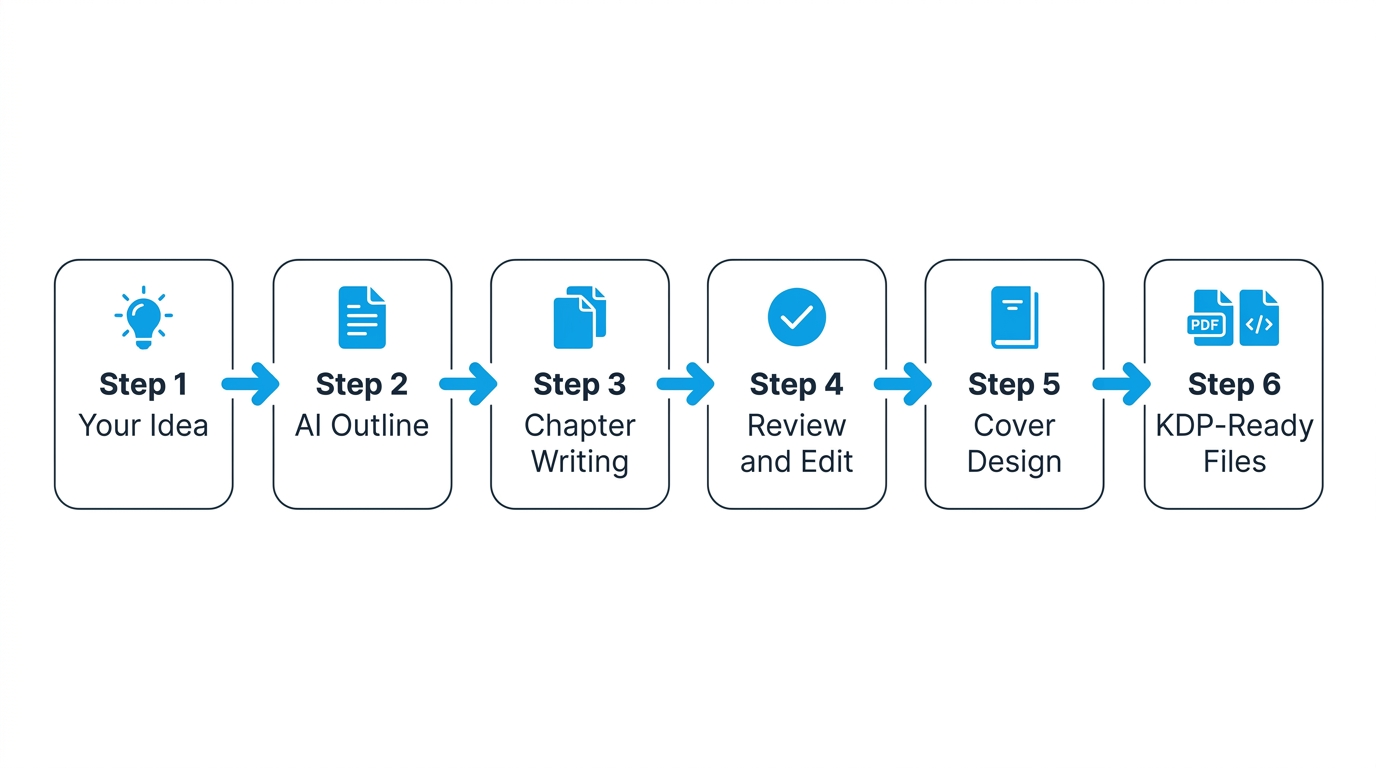
1. Start With Your Idea and Parameters
You provide the seed: your topic or premise, the target audience, the genre, and the general direction. Nonfiction authors might specify “a practical guide to urban gardening for apartment dwellers.” Fiction authors might describe a thriller about a forensic accountant who uncovers a multinational fraud. The more specific your starting point, the better the output.
At this stage you also set parameters: approximate word count, chapter count, tone (conversational vs. formal, humorous vs. serious), and any constraints (no profanity, include specific subtopics, target reading level).
2. AI Generates a Structured Outline
The AI produces a chapter-by-chapter outline with descriptions of what each section covers. This is probably the single most valuable step in the process. A good outline means the book has a logical flow, avoids repetition, and covers the subject properly.
You review and edit this outline before anything else gets written. Want to swap two chapters? Add a section on a subtopic? Remove something that’s off-target? This is where those decisions happen. Skipping outline review is the number one mistake people make with AI book writing, because every structural problem here compounds across every chapter.
3. Chapter-by-Chapter Generation
With an approved outline, the AI writes each chapter sequentially. Good tools maintain context across chapters, so chapter 7 can reference events or concepts from chapter 3 without you having to remind it. That continuity is what separates purpose-built book writing platforms from general-purpose chatbots.
Each chapter typically goes through its own review cycle. You read the output, flag sections that need revision, and the AI regenerates those parts. Some authors approve chapters one at a time. Others generate the full manuscript first and then do a single editing pass.
4. Editing and Revision
This is where the human element is non-negotiable. AI-generated text needs editing. Sometimes light editing (tightening prose, fixing occasional awkward transitions). Sometimes heavier work (restructuring arguments, adding personal anecdotes, adjusting the voice). More on this later.
5. Front and Back Matter
A publish-ready book needs more than just chapters. You need a title page, copyright page, table of contents, dedication (optional), author bio, and potentially an index. AI tools can generate these, but you’ll want to personalize at minimum the dedication and author bio.
6. Export and File Generation
The final step is producing publish-ready files. For Amazon KDP publishing, that means a formatted DOCX or PDF for the interior, an EPUB for the ebook, and cover files at specific dimensions. Platforms like BookSmith handle this formatting automatically, which saves you from the formatting rabbit hole that derails so many self-publishing projects.
What AI Does Well
AI writing tools have genuine strengths that make book production faster and more accessible. A few stand out:
- Structure and organization. AI is excellent at creating logical outlines, maintaining consistent chapter structures, and making sure a book covers its topic thoroughly. It won’t forget to address an important subtopic or leave a plot thread hanging (if the outline accounts for it).
- Consistent output. Unlike human writers, AI doesn’t have bad writing days. The quality of output stays relatively even across chapters, which means less variance to smooth out during editing.
- Speed. A 50,000-word manuscript that might take months of writing can be generated in hours. Even with review and editing factored in, you can go from idea to finished book in a fraction of the time.
- Formatting and logistics. The tedious parts of book production (file formatting, metadata generation, keyword research, marketing copy) are exactly the kind of structured tasks AI handles efficiently.
- Overcoming blank-page paralysis. For many authors, the hardest part is getting started. Having a structured outline and draft chapters to react to is far easier than staring at an empty document.
- Nonfiction breadth. For instructional, educational, or reference books, AI can synthesize information across a topic area and present it in a well-organized way. It’s particularly strong with how-to guides, overviews, and explanatory content.
What AI Doesn’t Do Well
Knowing the limitations upfront will save you from a disappointing result.
- Deeply personal stories. A memoir about your experience surviving cancer, raising a child with special needs, or building a company from nothing requires your specific memories, emotions, and perspective. AI can help structure and draft around those experiences, but the raw material has to come from you.
- Highly specialized expertise. If you’re writing about the latest advances in quantum computing or a niche legal topic, the AI may produce plausible-sounding content that misses important nuances. Domain experts need to review technical content carefully.
- Distinctive literary voice. AI can match a general tone (conversational, formal, humorous), but it won’t produce prose that sounds like Cormac McCarthy or Toni Morrison. If you’re aiming for a specific literary style, expect to do more hands-on editing.
- Original research and data. AI generates text based on patterns in its training data, not original investigation. It can’t interview sources, conduct experiments, or gather new statistics. Any claims need verification.
- Emotional depth in fiction. AI-generated fiction can plot competently and maintain narrative structure, but the moments that make readers cry or gasp typically need a human touch during editing.
How to Get the Best Results
The gap between mediocre AI-generated books and genuinely good ones almost always comes down to what the author puts in. A few things separate the two.
Be Specific About Your Vision
“Write a book about marketing” will give you generic results. “Write a practical guide to content marketing for B2B SaaS companies with less than 50 employees, focusing on strategies that don’t require a dedicated marketing team” will give you something useful. The more precisely you define your audience, scope, and angle, the more focused the output.
Invest Time in the Outline
Spend more time on the outline than you think you need to. Rearrange chapters. Question whether each section earns its place. Make sure the flow makes sense. A strong outline is the single biggest predictor of a strong finished book, whether you’re writing with AI or without it.
Specify Tone and Examples
Tell the AI what voice you want. “Write in a conversational, slightly irreverent tone, like a knowledgeable friend explaining things over coffee” is much more useful than “make it engaging.” If you have reference books whose style you admire, mention them. If certain phrases or approaches are off-limits, say so.
Review Chapter by Chapter
Don’t generate the entire manuscript and read it for the first time at the end. Review each chapter as it’s produced. Catch problems early. If chapter 3 drifts off-topic, you want to correct that before chapters 4 through 12 build on the wrong foundation.
Add Your Own Material
The books that stand out are the ones where the author adds what AI cannot: personal anecdotes, case studies from their own experience, original opinions, and specific examples from their field. Use AI for the framework and fill in the substance that only you can provide.
The Role of Human Editing
Nobody wants to hear this, but you still need to edit. AI gets you a solid draft faster than you could write one yourself, but a draft is still a draft.
At minimum, plan for these editing passes:
- Content review. Is the information accurate? Does each chapter deliver on what the outline promised? Are there gaps or redundancies?
- Voice and tone. Does it sound like you (or at least like the voice you want for this book)? Watch for places where the prose becomes generic or shifts register unexpectedly.
- Flow and transitions. Check how chapters connect. AI-generated chapters can sometimes feel like standalone essays rather than parts of a continuous narrative. Smooth the seams.
- Fact-checking. AI can confidently state things that are subtly wrong. Verify any specific claims, statistics, dates, or technical details against reliable sources.
- Final proofread. Catch typos, grammatical issues, and formatting inconsistencies. This is the easiest pass and the one most people skip, which is a mistake.
For nonfiction, a subject matter expert review is worth the time. For fiction, consider a beta reader or two before publishing. These steps apply to any book, AI-generated or not.
Fully AI-Generated vs. AI-Assisted: Two Approaches
There’s a spectrum of how much AI involvement makes sense, and it depends on your goals.
Fully AI-Generated
You provide the concept and parameters, review the outline, then let the AI produce the manuscript with minimal intervention. After generation, you do a single editing pass and publish.
Best for: informational nonfiction (how-to guides, reference books, educational content), low-content books, series production, and topics where thorough coverage matters more than personal voice.
AI-Assisted Writing
You use AI for the outline and first draft, then substantially rewrite and add your own material. The AI handles structure and initial prose; you supply the expertise, personality, and polish.
Best for: thought leadership books, memoirs with AI-structured frameworks, fiction where you want to maintain a specific voice, and any book where your personal brand is tied to the content.
Most authors land somewhere between these two poles. The right balance depends on your timeline, your confidence in your own writing, and how much of “you” the book needs to contain.
File Formats and Publishing Readiness
A finished manuscript is worthless if it isn’t in the right format for publication. Each major platform has specific requirements:
- Amazon KDP ebook: EPUB or DOCX file. EPUB is preferred for better formatting control. Standard fonts (Georgia, Garamond, or Times New Roman at 11-12pt for DOCX).
- Amazon KDP print: PDF with proper trim size (6" x 9" is the most common), embedded fonts, and correct margins. KDP has specific bleed and margin requirements that vary by page count.
- Cover files: JPEG at 1600 x 2560 pixels for ebook. PDF with spine width calculated from page count for print. These dimensions are non-negotiable.
- Metadata: Title, subtitle, author name, book description, 7 KDP keywords, BISAC category codes. Having this ready before you hit “publish” saves a lot of back-and-forth.
If formatting gives you a headache (and it gives most people a headache), this is one area where purpose-built tools earn their price. AI book writing platforms that handle end-to-end production will export KDP-ready files directly, saving you from learning the intricacies of PDF margins and EPUB structure.
Choosing the Right Tool
The AI book writing space has matured quickly. Your options range from general-purpose AI chatbots (which require you to manage everything manually) to specialized platforms that handle the full pipeline.
Key things to evaluate:
- Context management. Does the tool maintain awareness across chapters, or does each chapter start from zero? Cross-chapter continuity is essential for a book that reads as a cohesive whole.
- Output quality. Test with your specific genre or topic. Some tools handle nonfiction better than fiction, or vice versa.
- Export formats. Can it produce publish-ready files (DOCX, EPUB, PDF), or does it just give you raw text that you need to format yourself?
- Review workflow. Can you review and revise at the outline and chapter level, or is it all-or-nothing generation?
- Pricing model. Per-book pricing is usually more predictable than token-based pricing, especially for longer manuscripts.
For a detailed breakdown, see our comparison of AI book writing tools. And if you want to try the process yourself, BookSmith gives you a free outline so you can evaluate the output quality before committing.
Common Mistakes to Avoid
After seeing thousands of AI-generated books, the same patterns keep leading to poor results:
- Skipping the outline review. The outline is your blueprint. Publishing a book with a bad structure is like building a house on a crooked foundation.
- Zero editing. Unedited AI output reads like unedited AI output. Readers can tell. Even a single careful editing pass makes a significant difference.
- Being too vague. “Write a self-help book” produces generic results. Specificity is your biggest lever for quality.
- Ignoring formatting. A great manuscript in the wrong format gets rejected by publishing platforms or looks terrible on readers’ devices.
- Not adding your perspective. The books that sell are the ones with a clear point of view. AI provides the scaffold. You provide the substance.
Is AI Book Writing Right for You?
If you have a book idea and the thought of writing 50,000 words feels overwhelming, AI tools can get you from concept to manuscript faster than any method that came before. If you’re a subject matter expert who knows your topic inside out but struggles with the actual writing, AI is almost certainly a good fit.
If you’re producing content at scale (educational series, reference guides, instructional material), the efficiency gains are substantial.
If you’re writing literary fiction and every sentence matters to you, AI might serve better as a brainstorming and outlining partner rather than a prose generator. If your book depends entirely on original research, AI can help with structure and presentation, but the core content still needs to come from your work.
The honest answer for most people: AI book writing tools won’t replace the need for you to bring your ideas, knowledge, and editorial judgment. What they will do is handle the parts of book production that used to take months and turn them into days. Whether that trade-off makes sense depends on what you’re trying to build and how much of the process you want to own.
The barrier to writing a book has never been lower. The question is no longer whether you can write a book. It’s whether you have something worth saying. If you do, the tools are ready.