First-time authors always want to know: how much does it cost to self-publish a book? The answer used to be short: a lot. But in 2026, the range has widened dramatically. You can spend $7,000 or more going the traditional self-publishing route, or you can get a complete, publish-ready book for under $100 using AI-assisted tools.
This guide breaks down every cost involved in self-publishing, from the non-negotiables to the things you can safely skip. Big budget or bootstrapping on savings, you'll know exactly where your money should go.
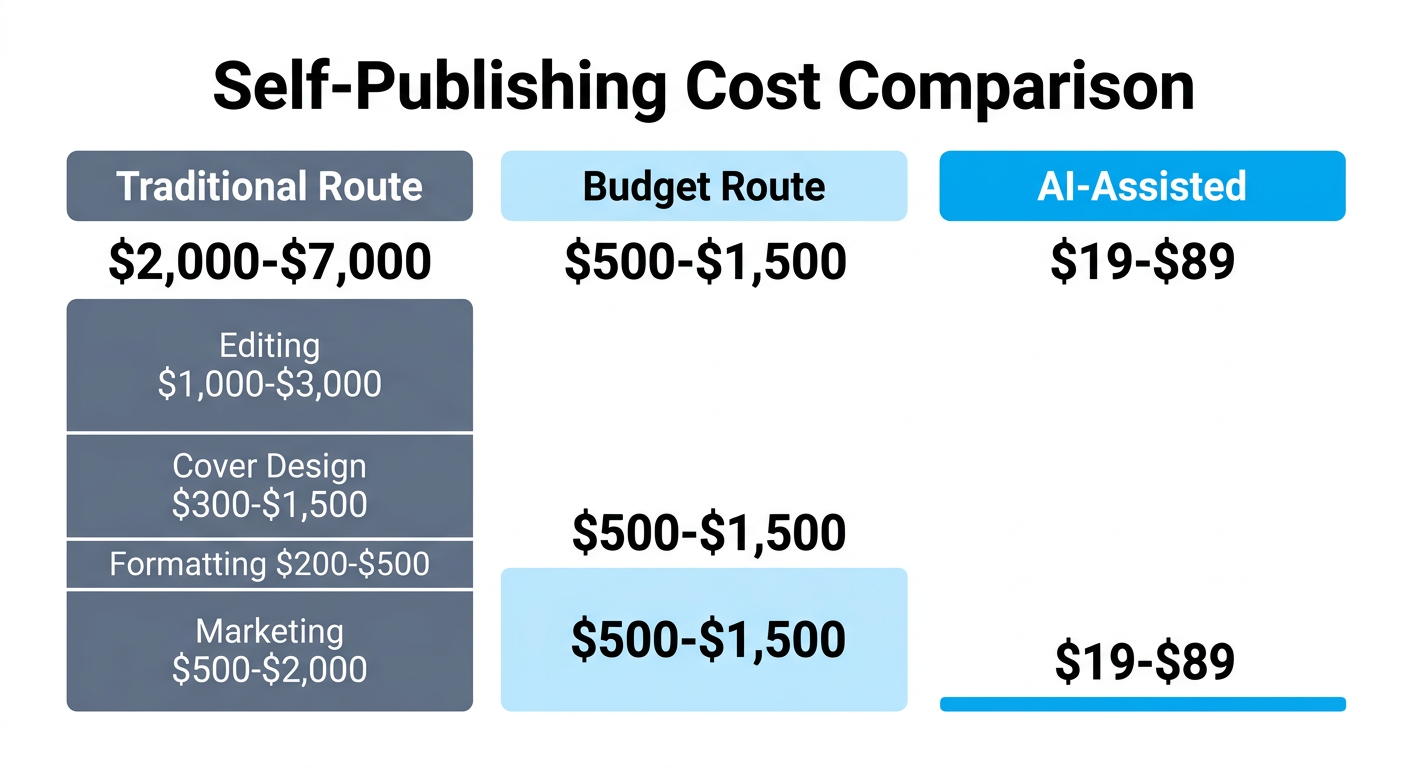
The Traditional Self-Publishing Cost Breakdown
If you hire professionals for every stage of book production, the way most self-publishing guides have recommended for the past decade, here's what you're looking at:
Editing: $1,000 – $3,000
This is typically the largest single expense. A developmental edit (restructuring, pacing, character arcs) runs $1,500 to $3,000 for a standard-length manuscript. A copy edit (grammar, consistency, clarity) costs $800 to $1,500. Many authors pay for both, pushing the total past $3,000.
Proofreading alone, the final pass for typos and formatting errors, runs $300 to $600.
Cover Design: $300 – $1,500
A professional cover designer charges $300 to $600 for a solid ebook cover. If you need a full paperback wrap (front, spine, back), expect $500 to $1,000. Premium designers with genre-specific portfolios charge $1,000 to $1,500. Pre-made covers are cheaper ($50 to $200) but less distinctive.
Interior Formatting: $200 – $500
Getting your manuscript formatted for Kindle (reflowable ebook) and print (fixed-layout PDF) typically costs $200 to $500. This includes setting margins, headers, page breaks, table of contents, and front/back matter. Some formatters charge per format: $150 for ebook, $250 for print. Producing both adds up.
ISBN: $125
A single ISBN from Bowker costs $125 in the US. A block of 10 costs $295, which makes sense if you plan to publish multiple books or editions. Amazon provides free ISBNs for KDP titles, but these lock you into their platform. If you want to distribute widely, you'll want your own.
Marketing: $500 – $2,000+
This category is open-ended, but most first-time authors spend at least $500 on launch marketing. That might include Amazon Ads ($300 to $1,000 for initial testing), a book launch email service ($100 to $300), social media graphics ($50 to $200), and review copies sent to book bloggers ($50 to $100 in shipping).
Authors who invest heavily in ads or hire a publicist can easily spend $2,000 to $5,000 before they see meaningful returns.
Traditional Total: $2,000 – $7,000+
Add it all up and the typical self-publishing budget looks like this:
- Budget approach: $500 – $1,500 (pre-made cover, basic copy edit, self-formatted)
- Standard approach: $2,000 – $4,000 (professional cover, copy edit, formatting, modest marketing)
- Premium approach: $5,000 – $7,000+ (developmental edit, custom cover, professional formatting, launch campaign)
These numbers have held steady since the early 2020s. But there's now a fourth option.
The AI-Assisted Approach: $19 – $89
AI book production tools have collapsed the cost structure for self-publishing. Instead of hiring separate professionals for writing assistance, cover design, formatting, and marketing copy, a platform like BookSmith handles all of it in one pipeline.
BookSmith's pricing is based on word count, not the number of services:
- Short books (up to 15,000 words): $19
- Standard books (up to 40,000 words): $39
- Long books (up to 70,000 words): $59
- Epic books (up to 100,000 words): $89
For that price, you get a complete manuscript, a professional cover, KDP-ready files (PDF, DOCX, and EPUB), marketing copy, keywords, and front/back matter. The outline is free — you only pay if you approve it and want the full book produced.
That's not a typo. The same deliverables that cost $3,000 to $5,000 through freelancers now cost less than a dinner out.
What's Actually Free
Before you budget anything, know what costs nothing:
- KDP account: Free to create, no monthly fees
- Amazon listing: No cost to list your book on the world's largest bookstore
- Print-on-demand: Amazon prints copies only when customers order them, so there are no upfront inventory costs
- KDP ISBN: Amazon provides a free ISBN, though it's exclusive to their platform
- Author Central page: Free author profile on Amazon
The print-on-demand model is what makes self-publishing viable at any budget. You never pay for unsold inventory. Amazon takes a printing cost per copy sold, and you keep the rest as your royalty. For a detailed walkthrough of the entire KDP process, see our complete guide to self-publishing on Amazon KDP.
Where to Spend vs. Where to Save
Not all self-publishing expenses are created equal. Here's where your money matters most and where you can cut without hurting your book.
Worth Spending On
- Cover design: Readers judge books by their covers. Literally. A bad cover tanks your click-through rate on Amazon before anyone reads a single word. If you're not using an AI tool that generates covers, this is the last place to cut corners.
- Proofreading: Even if you skip developmental editing, a final proofread catches the errors that make a book look amateur. At $300 to $600, it's the highest-ROI editing spend.
- Initial ad testing: A $300 to $500 Amazon Ads budget lets you test whether your book, cover, and description convert. You'll learn more from $300 in ads than from $300 in social media posts.
Safe to Skip or Minimize
- Author website: Nice to have, but Amazon is where 99% of sales happen. A free Linktree or simple landing page works fine for your first book.
- Book trailer videos: Low conversion, high cost. Skip these entirely unless you have an existing YouTube audience.
- Paid blog tours: Most book blog tours cost $100 to $400 and generate minimal sales. Your money is better spent on Amazon Ads.
- Vanity press packages: Any company charging $3,000 to $10,000 for an all-in-one “publishing package” is overcharging. You can get the same results for a fraction of the cost.
Hidden Costs People Forget
Your self-publishing budget should account for several expenses that don't show up in most cost breakdowns:
- Proof copies: $5 to $10 per copy, and you'll want at least 2 to 3 to check formatting, margins, and print quality before going live. Budget $15 to $30.
- Revisions: If you hire a cover designer or editor, revisions beyond the initial scope cost extra. Clarify revision policies upfront.
- Ongoing ad spend: Your launch budget is just the beginning. Successful self-published authors reinvest 20% to 40% of royalties into advertising. Plan for $100 to $300 per month once your book is live.
- Copyright registration: Optional but recommended. $65 for online registration with the US Copyright Office.
- Multiple formats: If you want hardcover, large print, or audiobook editions, each format has its own production cost. Audiobook narration alone runs $1,000 to $5,000 for a full-length book.
- Time: This is the biggest hidden cost. Learning formatting, writing marketing copy, designing covers in Canva, researching keywords. Those hours add up. For many authors, the time cost dwarfs the dollar cost.
ROI: How Many Copies to Break Even
The real question is not just how much self-publishing costs. It's how quickly you earn it back. Here's a straightforward break-even calculation at different investment levels and price points.
Assuming a 70% Kindle royalty (books priced $2.99 to $9.99) and a $3 to $5 per-copy profit on paperback after Amazon's printing costs:
Ebook at $4.99 (royalty: ~$3.49 per sale)
- $89 investment (BookSmith): 26 copies to break even
- $1,500 budget approach: 430 copies to break even
- $4,000 standard approach: 1,146 copies to break even
Ebook at $9.99 (royalty: ~$6.99 per sale)
- $89 investment (BookSmith): 13 copies to break even
- $1,500 budget approach: 215 copies to break even
- $4,000 standard approach: 572 copies to break even
Paperback at $14.99 (profit: ~$4.00 per sale)
- $89 investment (BookSmith): 23 copies to break even
- $1,500 budget approach: 375 copies to break even
- $4,000 standard approach: 1,000 copies to break even
The math is stark. At a $4,000 investment, you need to sell over a thousand copies just to get your money back. The median self-published book sells fewer than 250 copies in its lifetime. At $89, you're profitable after selling to friends and family.
How AI Is Changing the Economics
The cost shift in self-publishing goes beyond cheaper tools. It changes who can afford to publish at all.
Five years ago, the $2,000 to $5,000 barrier meant self-publishing was a gamble. You spent thousands upfront with no guarantee of earning it back. That risk filtered out most people who had books in them but couldn't justify the financial exposure.
AI-assisted publishing removes that barrier. When the total cost is under $100, publishing a book carries roughly the same financial risk as buying a new pair of shoes. The downside is capped. The upside is unlimited.
A few reasons that matters:
- First-time authors can experiment. Write a short nonfiction book to test an idea. If it sells, write a longer follow-up. The low cost means you can iterate instead of betting everything on one title.
- Series economics improve dramatically. Publishing a 3-book series used to cost $6,000 to $15,000. Now it costs $60 to $270. Series are where the real money is in self-publishing, and low production costs make them viable for everyone.
- Speed to market is measured in days, not months. Traditional self-publishing timelines, from 3 to 6 months from finished manuscript to published book, have compressed to under a week. Faster publishing means faster feedback and faster iteration.
The trade-off is real: AI-generated content requires careful review, and some genres demand a human touch that AI can't fully replicate. But for nonfiction, genre fiction, and content-driven books, the quality gap has narrowed significantly. For a deeper look at how this compares to the traditional publishing path, read our self-publishing vs. traditional publishing comparison.
A Realistic Self-Publishing Budget for 2026
Here's what we'd recommend for a first-time author who wants a professional result without overspending:
- Book production (writing, covers, formatting, marketing copy): $39 to $89 via BookSmith, depending on length
- Proofreading: $300 to $600 for a human proofread of the final manuscript (optional but recommended)
- ISBN: $0 (use the free KDP ISBN) or $125 for your own
- Proof copies: $15 to $30
- Amazon Ads (first month): $300 to $500
Total: $350 to $1,350 for a professionally produced, market-ready book with an initial advertising push. That's less than the editing cost alone in the traditional model.
If you're on a tight budget, cut the human proofread and the ISBN. Use the free KDP option, rely on AI-generated content with careful self-review, and start ads at $5 per day. Your all-in cost: under $200.
Bottom Line
Self-publishing a book in 2026 costs somewhere between $19 and $7,000, depending on how you approach it. The traditional path still works — hiring editors, designers, and formatters produces excellent results if you have the budget. But it's no longer the only path to a professional book.
AI-assisted tools have made it possible to produce a complete, publish-ready book for the cost of a restaurant meal. That doesn't mean quality is automatic. You still need a good idea, careful review, and smart marketing. But the financial barrier that kept most aspiring authors on the sidelines? It's gone.
Start with a free outline and see what your book would look like before you spend a cent.